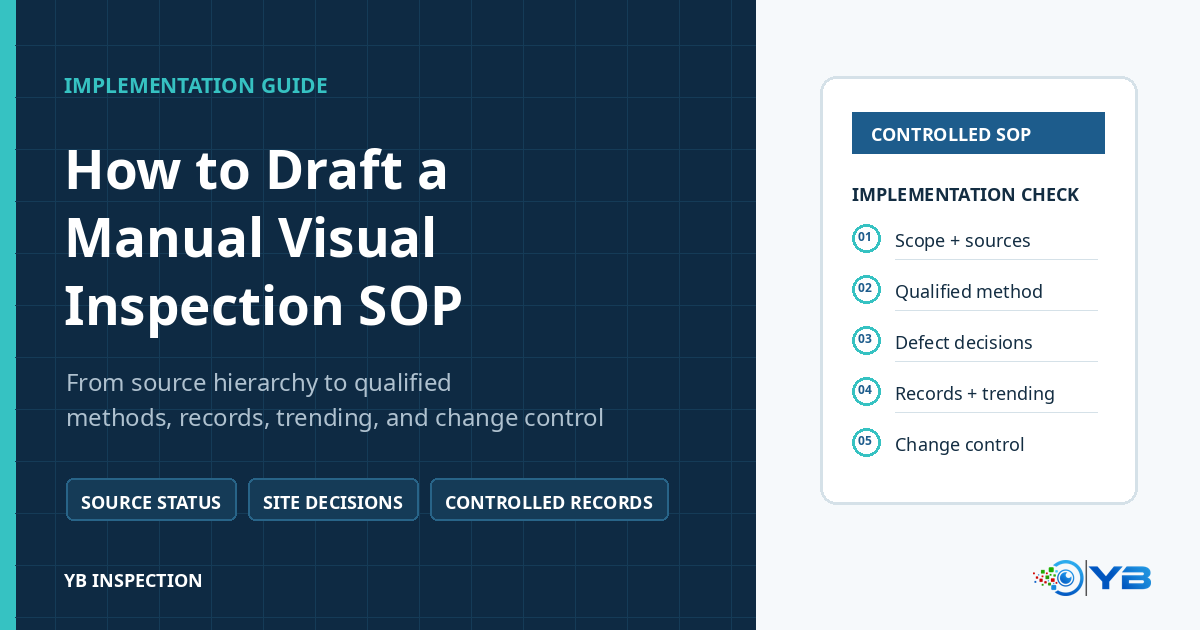
A manual visual inspection standard operating procedure should do more than describe how an operator holds a vial against black and white backgrounds. It must connect the qualified inspection method to personnel status, equipment readiness, defect decisions, reconciliation, acceptance sampling, investigations, trending, and batch disposition.
The difficult part is that not every important value belongs in a generic template. Inspection conditions, pacing, session duration, defect standards, qualification criteria, sampling plans, and alert limits may depend on the product, container–closure system, process capability, market, and approved quality system. A useful SOP therefore separates applicable requirements from guidance, examples, and site-defined decisions.
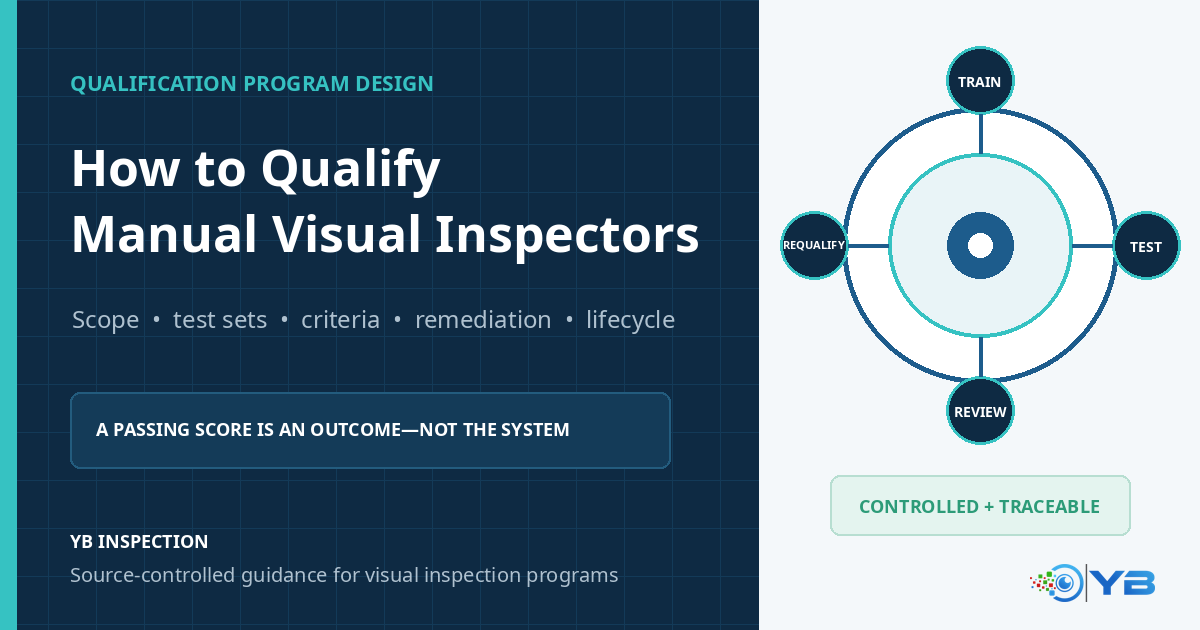
A strong SOP is not the inspection program. It is the controlled instruction that connects the validated or qualified parts of that program and tells personnel what to do, what to record, and when to escalate.
Start With the Source Hierarchy
In the United States, written production and process-control procedures must be drafted, reviewed, and approved by the appropriate organizational units and reviewed and approved by the Quality Control Unit. Deviations from those procedures must be recorded and justified.[1] Laboratory controls, including specifications, standards, sampling plans, and test procedures, must be scientifically sound and approved by the Quality Control Unit.[2]
For parenteral products supplied to markets governed by EU GMP Annex 1, all filled containers should be inspected individually for extraneous contamination or other defects. The Annex also addresses risk-based defect classification, defect libraries, controlled manual inspection conditions, inspector qualification, and the recording and trending of inspection results.[3] WHO TRS 1044 Annex 2 contains closely aligned expectations in paragraphs 8.30–8.33.[4]
FDA’s December 2021 document on visible-particle inspection is still identified by FDA as draft guidance containing nonbinding recommendations. It recommends a holistic, risk-based approach across the product lifecycle, but it should not be described as binding law or as final guidance.[5]
USP chapters also matter, but they do not eliminate the need to define a complete CGMP system. USP <790> contains the compendial procedure and acceptance framework for visible particulates in applicable injections, while USP <1790> is an informational chapter on the visual inspection of injections. The public <1790> abstract emphasizes that visual inspection is probabilistic and that detection capability varies with dosage form, particle characteristics, and container design.[6] [7]
| Source type | What it should control in the SOP | What still requires a site decision |
|---|---|---|
| Applicable law and CGMP regulation | Procedure approval, documentation, laboratory-control governance, record review, and investigations | Roles, forms, electronic workflow, and escalation timelines |
| Market-specific GMP guidance | Complete inspection, defect classification, qualification, controlled conditions, trending, and lifecycle review | How those expectations are implemented for the actual product and site |
| Licensed compendia | Applicable test procedures, acceptance criteria, and official terminology | Product applicability, internal production controls, and integration with the batch process |
| Validation and qualification evidence | Qualified inspection presentation, station setup, rate, challenge conditions, and system capability | Routine instructions, status checks, and change triggers |
| Site quality system | Document control, training, deviations, investigations, CAPA, change control, and disposition | The approved process personnel must follow |
Define Scope Before Writing the Procedure
The scope should identify the products, strengths, dosage forms, container–closure systems, sizes, inspection modes, manufacturing lines, sites, process stage, and defect attributes covered. It should also identify excluded or difficult-to-inspect configurations and point to an approved supplemental or alternative method.
This distinction matters because an instruction written for a clear solution in a transparent vial may not be suitable for a colored solution, suspension, lyophilized cake, amber container, prefilled syringe with device components, or another presentation that limits detection. USP <1790> explicitly notes that product and package characteristics can limit inspectability.[7]
The scope should also state whether the procedure covers:
- routine 100% production inspection;
- semi-automated presentation with a human decision;
- acceptance sampling after complete inspection;
- reinspection under an approved exception process;
- container and closure defects in addition to visible particles; and
- inspection before or after labeling, device assembly, or secondary packaging.
Connect Responsibilities to Decisions
A procedure should assign more than the act of inspection. The Quality Unit should approve the procedure, acceptance criteria, defect classifications, qualification program, sampling plan, investigations, and batch disposition. Operations should control execution, segregation, reconciliation, and contemporaneous records. Engineering or metrology should maintain the qualified station and calibrated measuring equipment. Training owners should maintain curricula, inspector status, challenge sets, and requalification records.
Batch disposition responsibilities should also be explicit. U.S. batch records must include complete information relating to production and control, including inspection results and identification of the people performing or checking significant steps.[8] Before release or distribution, production and control records must be reviewed and approved by the Quality Control Unit; unexplained discrepancies and certain failures require investigation.[9]
Build a Readiness Gate Before the First Unit
An inspector should not begin merely because a batch is available. A controlled readiness section should require confirmation of:
- Current personnel qualification. The inspector is trained and currently qualified for the relevant product, package, and defect families.
- Equipment status. The station, light source, backgrounds, product-handling equipment, and illuminance meter are identified and within qualification, calibration, and maintenance status.
- Product readiness. Required hold, temperature-equilibration, mixing, settling, degassing, or bubble-dissipation conditions have been met.
- Current standards and records. The approved work instruction, defect library, batch record, reject codes, and acceptance-sampling instruction are available in their current revisions.
- Process capacity. The qualified inspection rate, session limit, break schedule, staffing, and segregation controls can be maintained.
EU GMP Annex 1 and WHO TRS 1044 state that manual inspection should occur under suitable and controlled illumination and background conditions, with appropriately controlled and qualified inspection rates. They also address minimizing distractions and taking breaks of appropriate duration.[3] [4]
Write the Inspection Sequence From Qualified Evidence
The SOP should point to, or contain, the approved sequence for presenting each container. That may include orientation, motion, stabilization, viewing angle, distance, backgrounds, viewing time, and the order in which the contents, container, closure, and cosmetic attributes are examined.
Those values should come from the current applicable method and the site’s qualification or validation evidence. A template should not invent a universal illuminance value, viewing time, rotation method, or units-per-minute limit. Even when a compendial condition applies to a specific test, the routine production process may require additional controls and documented evidence of capability.
The decision pathway should be equally clear. The instruction should define what happens when a unit is acceptable, defective, damaged during handling, or indeterminate. Rejected units should enter a secure, identified, reconcilable stream and should not return to accepted product without an approved disposition process.
Keep Defect Classification Separate From Detectability
Defect criticality should be based on potential patient and product-quality risk, not simply on whether a defect is easy to see. EU GMP Annex 1 and WHO TRS 1044 call for defect classification and criticality to be determined during qualification using risk and historical knowledge, including the potential patient impact and route of administration.[3] [4]
The procedure should link to a controlled defect taxonomy and library. At minimum, the system should address:
- known defect categories and approved codes;
- critical, major, and minor classifications with documented rationale;
- inherent, intrinsic, and extrinsic particles where that terminology is used;
- unknown or newly observed defects;
- defect-standard identity, custody, storage, integrity checks, and lifecycle status; and
- the investigation pathway when a critical or unclassified defect is found.
The SOP should not attempt to reproduce the entire defect library. Instead, it should define how the current library is accessed, how new observations are escalated, and how records remain traceable to the applicable library version.
Treat Acceptance Sampling as Verification, Not Replacement
Where acceptance sampling follows 100% inspection, the SOP should identify the approved sampling standard, inspection level, AQL or other criteria, sample-selection method, defect-category rules, accept/reject numbers, and escalation pathway. It should not copy proprietary ISO or ANSI sampling tables into a public or uncontrolled document.
The sample should represent the accepted population and the batch. The procedure should also explain what happens when a critical defect is found during later sampling. EU GMP Annex 1 states that a critical defect found during subsequent sampling and inspection of acceptable containers should trigger an investigation because it may indicate failure of the original inspection process.[3]
Define Reinspection Before a Failure Occurs
Reinspection should not be improvised after an undesirable result. The SOP should state when reinspection is permitted, who approves it, what scientific justification is required, whether the method changes, which population is included, and how the results feed the investigation and batch decision.
The governing principle is straightforward: do not reinspect solely to obtain a passing result. A preapproved, scientifically justified, limited, and documented reinspection process is fundamentally different from repeating an activity until an acceptable number appears.
Make the Records Support Trending and Investigation
The batch record should reconcile units presented, accepted, rejected, sampled, destroyed, damaged, held, and otherwise dispositioned. It should record the inspector, station, time or segment, defect codes, interruptions, deviations, and sampling result at the level needed for investigation and trending.
EU GMP Annex 1 and WHO TRS 1044 state that inspection results should be recorded and defect types and numbers trended. They also call for the investigation of batches with unusual defect levels and adverse trends.[3] [4]
Reject-rate limits should therefore be connected to a defined denominator, baseline population, statistical method, review frequency, and escalation rule. One fixed percentage applied to every product and line is rarely an adequate substitute for process-specific trend analysis.
Include Training, Change Control, and Periodic Review
EU GMP Annex 1 and WHO TRS 1044 call for manual inspectors to undergo qualification at least annually, including consideration of corrective lenses normally worn, eyesight checks, appropriate defect-library samples, and worst-case factors such as inspection time, rate, container size, and fatigue.[3] [4]
The SOP should identify the site’s qualification design, acceptance criteria, failure response, re-entry after absence, and triggers for additional qualification. It should also define changes that require impact assessment or requalification, such as changes to formulation, color, viscosity, container, closure, component supplier, labeling, lighting, station design, conveyor speed, inspection sequence, defect library, software, or sampling plan.
What a Generic Template Should Never Decide for You
| Do not copy automatically | Why it must be justified |
|---|---|
| A fixed illuminance range | Applicability depends on the governing method and qualified station design |
| One viewing time or inspection speed | Capability varies with product, package, defect, presentation, and inspector factors |
| A universal inspector pass score | Qualification design and acceptance criteria require scientific and risk rationale |
| A prefilled AQL table | Sampling standards may be proprietary and must be applied correctly to the actual lot and defect categories |
| Fixed reject-rate alert/action limits | Limits require a defined denominator, baseline, statistical method, and process context |
| Defect criticality copied from another product | Patient risk can change with defect type, product, route, and clinical use |
A Practical Implementation Sequence
Begin with a gap assessment against the applicable regulations, markets, licensed compendia, approved registrations, and site quality system. Map each requirement to the product and package families. Then define the qualified inspection method, defect taxonomy, inspector qualification program, sampling plan, records, investigation pathway, and trend controls. Draft the SOP only after those inputs are understood.
Finally, route the document through technical review, Quality Unit approval, document control, training, and effective-date implementation. The SOP should be maintained through change control and periodic review—not treated as a one-time writing exercise.
Download the Editable Starter Kit
YB Inspection has published an original Manual Visual Inspection Program Starter Kit containing an editable Word SOP framework and Excel worksheets for station readiness, batch records, inspector qualification, defect-library control, and reject-rate trending.
Download the Manual Visual Inspection Program Starter Kit
The files are educational starting tools. They require site-specific applicability review, scientific justification, qualification or validation where appropriate, Quality Unit approval, and control through the user’s pharmaceutical quality system.
References
- 21 CFR 211.100 — Written procedures; deviations
- 21 CFR 211.160 — General requirements
- European Commission — EU GMP Annex 1: Manufacture of Sterile Medicinal Products (2022)
- WHO TRS 1044 Annex 2 — GMP for Sterile Pharmaceutical Products (2022)
- FDA — Inspection of Injectable Products for Visible Particulates, Draft Guidance for Industry (December 2021)
- USP <790> — Visible Particulates in Injections
- USP <1790> — Visual Inspection of Injections
- 21 CFR 211.188 — Batch production and control records
- 21 CFR 211.192 — Production record review