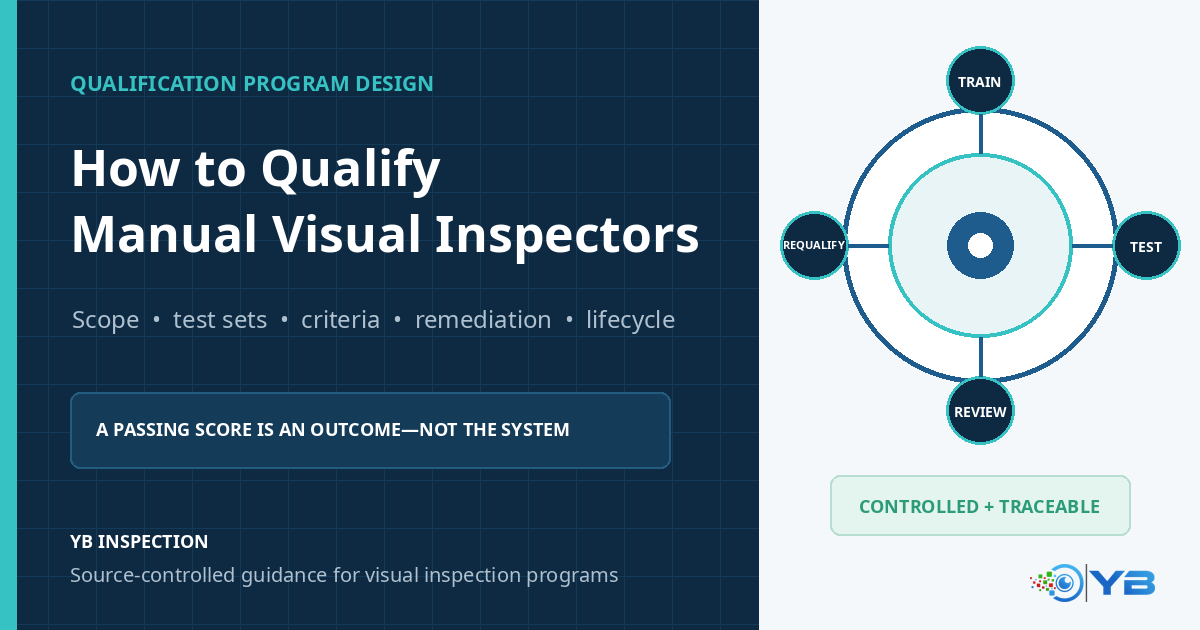
Inspector qualification is often reduced to a simple question: Did the candidate pass the test set? That question matters, but it is not enough. A defensible qualification program must show that the candidate was trained for the assigned task, evaluated under appropriate conditions, challenged with a controlled and representative set, assessed against scientifically justified criteria, and assigned a clearly defined scope and status.
The qualification event is therefore not an isolated examination. It is one controlled element within the broader visual inspection system.
A passing score is an outcome. A qualification program is the evidence system that makes the outcome credible.
Begin With the Applicable Source Hierarchy
In the United States, 21 CFR 211.25 requires each person engaged in drug manufacturing to have the education, training, and experience needed for assigned functions. Training must cover the employee’s particular operations and applicable CGMP requirements, and CGMP training must continue with sufficient frequency to keep personnel familiar with those requirements.[1]
The regulation does not prescribe one universal visual-inspector test-set size, passing score, number of trials, eyesight threshold, or annual requalification interval. Those elements must be established through the applicable quality system and supported by the actual inspection task, product, package, method, and risk.
FDA’s December 2021 document on visible-particle inspection contains detailed recommendations for inspector training and qualification, but it remains draft guidance containing nonbinding recommendations and is not for implementation.[2] The document recommends trained and certified inspectors, appropriate visual capability, controlled test sets containing both acceptable and defective units, Quality Unit oversight, masking of test-set identity, representative defects, and protocols that define test duration, grading, acceptance criteria, failure actions, and requalification.
EU GMP Annex 1 and WHO TRS 1044 Annex 2 are more explicit about frequency. Their paragraph 8.31 states that operators performing manual visual inspection should undergo qualification at least annually, using normally worn corrective lenses where applicable and appropriate samples from the manufacturer’s defect-library sets. Both also identify worst-case considerations such as inspection time, line speed where containers are conveyed to the operator, container size, and operator fatigue, and both call for consideration of eyesight checks.[3] [4]
| Source | What it contributes | What it does not automatically define |
|---|---|---|
| 21 CFR 211.25 | Personnel competence and continuing CGMP training | A universal annual interval or visual-inspection passing score |
| FDA December 2021 draft | Detailed nonbinding recommendations for training, test sets, protocols, and requalification | Binding law or a final FDA requirement |
| EU GMP Annex 1 | At-least-annual qualification and explicit worst-case considerations | A universal numerical passing threshold |
| WHO TRS 1044 Annex 2 | Closely aligned annual qualification and controlled-condition expectations | A single global qualification design |
| USP <1790> | Informational principles for visual inspection and its probabilistic nature | A substitute for the current licensed chapter, site evidence, or Quality Unit approval |
Define Exactly What the Inspector Is Being Qualified to Do
A qualification status should identify the task for which the inspector is authorized. It should not merely say “qualified for visual inspection.” The scope may need to identify the product or product family, formulation characteristics, container–closure system, container size, fill volume, defect families, inspection station, manual or semi-automated presentation method, and manufacturing line.
This specificity matters because visual inspection is probabilistic. Detection performance changes with the formulation, particle or defect characteristics, package design, and inspection conditions.[5] An inspector who performs well with a clear, low-viscosity solution in a transparent vial has not automatically demonstrated equivalent performance with an amber vial, syringe, cartridge, suspension, highly viscous biologic, or device-assembled presentation.
A site may use a family or bracketing strategy, but the grouping and worst-case member should be scientifically justified. The protocol should state which variables are considered equivalent, which condition is expected to be most challenging, and what change would require reassessment or requalification.
Establish Candidate Prerequisites Before Testing
Qualification should not be the first exposure to the inspection task. Before a blinded evaluation begins, the program should verify that the candidate has completed the approved curriculum, understands the inspection procedure, has practiced the required presentation technique, can use the defect taxonomy, and is eligible for the assigned task.
The curriculum may include CGMP responsibilities, product and package characteristics, inspection-station setup, container handling, defect examples, decision rules, segregation, documentation, and escalation. The organization should define how trainers are qualified, how supervised practice is documented, and who determines that the candidate is ready for the qualification event.
Vision and color-perception requirements require careful wording. FDA’s draft recommends normal near visual acuity with or without corrective lenses and no impairment of color vision for inspector candidates.[2] EU GMP Annex 1 and WHO TRS 1044 state that qualification should occur while the operator wears corrective lenses if normally worn and should include consideration of eyesight checks.[3] [4]
These sources do not establish one universal 20/20 near-vision threshold for every program. The organization should select an assessment appropriate to the task, define the eligibility criterion and review frequency, document normally worn corrective lenses and relevant restrictions, and protect confidential medical information. The qualification record generally needs the program outcome and restrictions—not unnecessary clinical detail.
Build a Controlled and Representative Challenge Set
The challenge set is not merely a box of known rejects. It is a controlled reference system. FDA’s draft recommends a mixture of acceptable and defective units, Quality Unit approval and control, masked identity, and defective samples representative of particles likely to occur for the product and manufacturing process. It also recommends including examples near the lower limits of visual detection determined through threshold studies.[2]
FDA’s draft says that the percentage of defective units should typically not exceed 10–20%.[2] This wording is a recommendation in a draft document—not a mandatory universal ratio. A site must still justify the set size, defect proportion, defect distribution, number of presentations, and confidence provided by the design.
At minimum, challenge-set governance should address:
- Unique identity and answer-key control. Every unit should have a controlled identity, with a separate masked identity used during testing.
- Reference status. The approved method used to establish whether the unit is acceptable or defective should be documented.
- Representativeness. The set should challenge the actual defect families, products, packages, locations, contrasts, and detectability range within the qualification scope.
- Physical integrity. Units should be checked for leakage, deterioration, label changes, particle movement, altered defect visibility, or other changes that could invalidate their status.
- Custody and security. Storage, access, issue, return, reconciliation, and retirement should be controlled so candidates cannot learn the answer key or predictable sequence.
- Lifecycle change. New production defects, revised classifications, damaged standards, and set changes should move through the defect-library and change-control systems.
EU GMP Annex 1 and WHO TRS 1044 specifically connect qualification to appropriate samples from the manufacturer’s defect-library sets.[3] [4] This makes the relationship between the defect library and the qualification set important: the library establishes controlled defect knowledge, while the qualification set selects appropriate units to evaluate the assigned inspection task.
NIST SRM 1989 is a useful optional development for some applications. NIST describes it as an irregularly shaped particle-size reference material with nominal area-based diameters of 100, 150, and 220 µm, intended for training and qualifying visual inspection analysts.[6] It is not a regulatory requirement, does not represent every production defect, and is not a complete qualification set by itself.
Reproduce the Approved Task and Its Worst Cases
The qualification should represent actual conditions of use or a justified worst-case condition. EU GMP Annex 1 and WHO TRS 1044 name inspection time, conveyor line speed where applicable, container size, and operator fatigue as factors to consider.[3] [4] FDA’s draft also recommends scientifically based feasibility studies for visible-particle detectability, unit-inspection duration, illumination, and fatigue time frame.[2]
The protocol should therefore document the station, backgrounds, illumination or approved setting, presentation method, inspection rate, session timing, breaks, product/package family, defect mix, and selected worst-case conditions. If qualification is performed under easier conditions than routine production, the resulting status may not demonstrate capability for the assigned task.
Worst case should not be treated as a slogan. The program should explain why a specific product, package, fill, defect, pace, duration, or station represents the challenge. Where different variables create different detection problems, more than one qualification family or challenge condition may be needed.
Choose Performance Measures Before the Candidate Begins
Visual inspection performance contains at least two distinct risks: missing a defective unit and rejecting an acceptable unit. A useful analysis should therefore evaluate both detection and false rejection rather than relying only on total percent correct.
| Measure | What it shows |
|---|---|
| Defect-detection rate | The proportion of defective reference presentations correctly rejected |
| Missed-defect rate | The proportion of defective reference presentations incorrectly accepted |
| Good-unit acceptance rate | The proportion of acceptable reference presentations correctly accepted |
| False-reject rate | The proportion of acceptable reference presentations incorrectly rejected |
| Overall agreement | The proportion of all valid candidate decisions matching the approved reference |
| Defect- or unit-specific performance | Whether certain defect families or individual standards are driving error |
USP <1790> describes visual inspection as probabilistic, and a PDA technical article explains why an arbitrary requirement for 100% detection of every critical defect can create bias. Defect criticality reflects risk; it does not determine how visually obvious the defect will be.[5] [7]
The site should select and approve the statistical method, metrics, thresholds, number of trials, and decision rules before execution. A Knapp-style probability-of-detection comparison is one recognized approach, while attribute agreement analysis is another technical method discussed in industry literature.[7] [8] No single method should be labeled universally mandatory without considering the applicable standard, protocol purpose, data structure, and site justification.
The protocol should also state how ambiguous or invalid units are handled, when exclusions are permitted, who reviews calculations, and whether confidence intervals or unit-specific analyses are required. Criteria should not be changed after results are known merely to obtain a passing outcome.
Protect Blinding and Record Every Decision
The candidate should not know which units are defective, see the answer key, receive coaching during the test, or encounter a predictable presentation sequence. Each valid presentation should be traceable to the event, candidate, trial, sequence, station, qualification family, challenge-set version, masked unit, reference status, candidate decision, date and time, proctor, reviewer, and any deviation.
U.S. CGMP requires approved written procedures to be followed and documented at the time of performance, with deviations recorded and justified.[9] Laboratory-control mechanisms must be scientifically sound and Quality Unit approved, and complete data and calculations must be retained where the laboratory-record requirements apply.[10] [11]
The final qualification decision should be scope-specific. It should identify whether the candidate is qualified, qualified with restrictions, not qualified, suspended, expired, or pending review, and it should state the effective date, approved family, restrictions, approver, and next due date or trigger review.
Treat Failure as a Quality Event, Not a Retest Queue
A failed or invalid event should trigger a controlled pathway. The immediate response may include removal from unsupervised inspection, a restricted scope, supervised work, or pending status while the event is assessed.
The assessment should determine whether the result reflects candidate performance, inadequate training, an ambiguous or unstable standard, station conditions, incorrect protocol execution, a data error, or a broader method problem. The response should then target the identified cause through coaching, practice, curriculum changes, test-set correction, station correction, or another approved action.
FDA’s draft recommends that the qualification protocol define actions for test failures and specify requalification methods and frequency.[2] The program should also require documented authorization before retesting. Repeating the same examination until the candidate obtains a passing score weakens independence and may obscure the original failure.
The re-entry record should state the retest design, outcome, approved scope, restrictions, effective date, Quality Unit decision, and any effectiveness follow-up. Where a failure raises concern about prior routine performance, the organization should evaluate the appropriate period, products, records, and related inspection results through its deviation or investigation system.
Requalification Is Both Calendar-Based and Event-Driven
For programs within EU GMP Annex 1 or WHO scope, manual visual inspectors should be qualified at least annually.[3] [4] For a U.S.-only program, 21 CFR 211.25 requires continuing training at sufficient frequency, while FDA’s draft recommends periodic retraining or requalification as appropriate; the regulation itself does not state the same universal annual interval.[1] [2]
Calendar control is only part of the lifecycle. A program should define events that prompt reassessment, such as:
- an extended absence from the inspection task;
- repeated missed defects, false rejects, or adverse performance trends;
- a new product, formulation, container, closure, device, or defect family;
- a change to the station, illumination, presentation method, line speed, or inspection rate;
- a material change to the challenge set or baseline method;
- a change in corrective-lens status or program eligibility; or
- an investigation, complaint, audit observation, or CAPA that questions inspection capability.
The candidate-status register should make current authorization, restrictions, last qualification, next due date, and trigger review visible. Expired or suspended status should prevent assignment to unsupervised inspection until the approved re-entry process is complete.
Common Qualification Mistakes
| Mistake | Why it creates risk | Better control |
|---|---|---|
| Using one generic set for every product and package | It may not represent the actual inspection challenge | Define justified families and worst cases |
| Treating a familiar number as a regulation | It hides the absence of product- and site-specific rationale | Trace every criterion to evidence and approval |
| Requiring 100% detection only because a defect is critical | Criticality and visual detectability are different attributes | Evaluate against an approved detectability baseline and risk strategy |
| Ignoring acceptable units | A candidate can appear sensitive while producing excessive false rejects | Evaluate both defect detection and good-unit acceptance |
| Using unstable or compromised standards | The answer key may no longer be valid | Perform condition checks, quarantine, change control, and retirement |
| Allowing repeated tests until passing | It introduces learning and weakens independence | Investigate, remediate, authorize, and document retesting |
| Recording only “pass” or “fail” | It prevents reconstruction and root-cause analysis | Retain trial-level decisions, calculations, deviations, and review |
| Tracking only an annual date | Changes and adverse performance may require earlier action | Add event-driven reassessment triggers |
Use an Editable Framework Without Confusing It With an Approved Program
YB Inspection’s Visual Inspector Qualification Toolkit provides an editable Word protocol and ten-sheet Excel workbook for qualification decisions, candidate status, program eligibility, challenge-set inventory, blinded trial execution, performance analysis, failure and remediation, requalification planning, and audit readiness.
The workbook intentionally contains no universal passing score. Acceptance-criterion cells remain blank until the user enters approved values and rationale, and incomplete criteria return a review state rather than a pass. The bundle also separates binding requirements, GMP expectations, FDA draft recommendations, informational principles, technical practices, and site decisions.
Download the Visual Inspector Qualification Toolkit and adapt it through your organization’s document-control, validation, training, privacy, and Quality Unit approval processes.
References
- 21 CFR 211.25 — Personnel qualifications
- FDA — Inspection of Injectable Products for Visible Particulates, Draft Guidance for Industry (December 2021; nonbinding, not for implementation)
- European Commission — EU GMP Annex 1 (2022), paragraph 8.31
- WHO TRS 1044 Annex 2 — GMP for sterile pharmaceutical products (2022), paragraph 8.31
- USP General Chapter <1790> — Visual Inspection of Injections, official public abstract; verify current licensed chapter
- NIST — A Particle Size SRM for Training and Qualifying Visual Inspection Analysts (2025)
- PDA Letter — Qualification of Manual Visual Inspection Still Critical (2020)
- ISPE Pharmaceutical Engineering — Evaluation of Visual Inspection in Parenteral Products (2020)
- 21 CFR 211.100 — Written procedures; deviations
- 21 CFR 211.160 — General requirements
- 21 CFR 211.194 — Laboratory records