What Makes a Product Difficult to Inspect?
Not all injectable products present equal challenges for visual inspection. A clear, colorless aqueous solution in a tubular glass vial is the ideal case — particles are visible, backgrounds provide contrast, and standard methods work reliably. But a significant portion of the pharmaceutical portfolio falls outside this ideal.
PDA Technical Report No. 79 (2017) formally categorizes difficult-to-inspect products (DIPs) and provides a framework for addressing their unique challenges. Understanding which category your product falls into — and why it's difficult — is the first step toward designing an effective inspection strategy. — [PDA TR No. 79, 2017]
Categories of Difficult-to-Inspect Products
1. Lyophilized Products
Lyophilized (freeze-dried) products present multiple challenges:
- Cake variation: Normal cakes exhibit shrinkage, surface texture differences, color variation, and partial collapse — all acceptable but visually variable
- Reconstitution requirement: Particles may only become visible after reconstitution, requiring a two-stage inspection approach
- Cake defects vs. particulates: Distinguishing cake fragments (inherent) from extrinsic contamination requires trained judgment
- Container headspace: Lyophilized products have large headspace that can accumulate condensation or particles on the stopper
Strategy: SAVI with trained operators is often preferred over AVI for lyophilized products due to the judgment required to distinguish normal cake variation from true defects. Supplemental inspection after reconstitution (for a statistical sample) provides additional assurance. — [PDA TR No. 79, 2017; USP <1790>, 2017]
2. Suspensions and Emulsions
Opaque or semi-opaque liquid products fundamentally limit visual detection:
- Particle masking: The product's inherent opacity hides particles that would be visible in clear solutions
- Normal appearance variation: Settling, creaming, or phase separation may be normal but looks similar to contamination
- Reduced contrast: Standard black/white backgrounds provide minimal contrast improvement for opaque products
Strategy: Focus visual inspection on container/closure defects and gross contamination. Supplement with destructive testing of a statistical sample — withdraw contents into a clear container for particle examination. Enhanced subvisible particle testing (USP <788>) provides additional control. — [PDA TR No. 79, 2017]
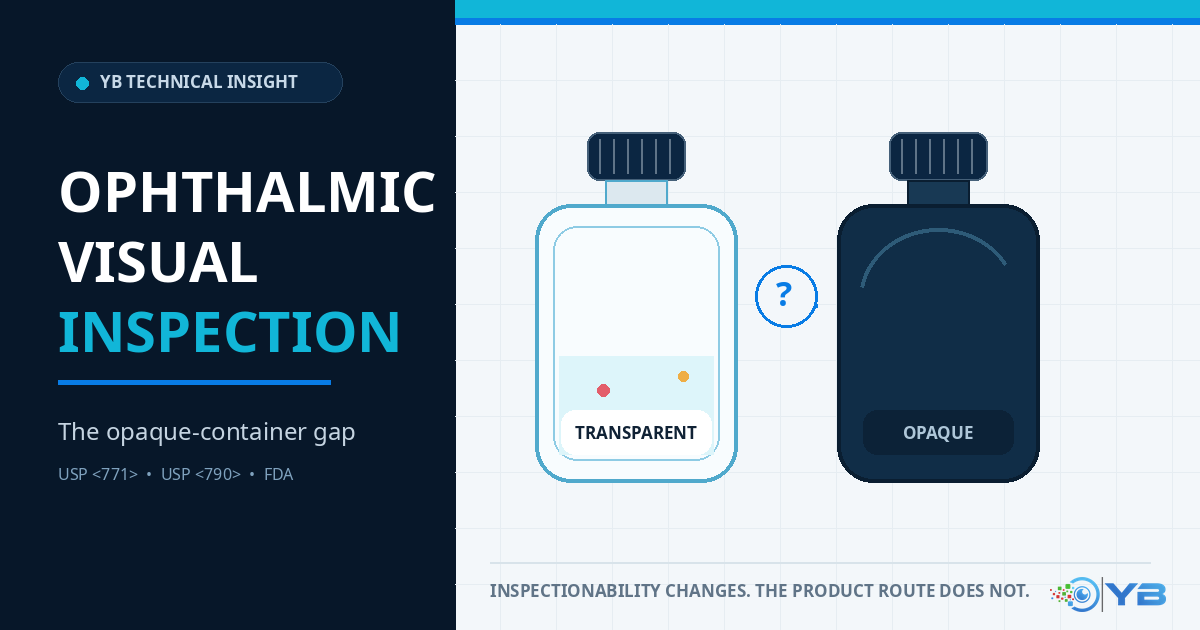
3. Opaque Containers
Amber glass, colored plastic, and other opaque container materials reduce or eliminate visibility of contents:
- Amber glass: Reduces light transmission, masking particles — particularly problematic for dark-colored defects
- Plastic containers: May be translucent or opaque depending on material and thickness
- Blow-fill-seal: Formed polymer containers with limited optical clarity
Strategy: Higher lux lighting (up to maximum tolerable without creating glare), specialized wavelengths that penetrate the container material, transmitted light techniques, and destructive sampling for particle assessment. — [PDA TR No. 79, 2017]
4. High-Concentration Biologics
Modern biologics at concentrations of 50–200+ mg/mL present unique challenges:
- Inherent opalescence: Protein solutions scatter light, creating a hazy appearance that masks particles
- Protein aggregates: Visible aggregates may be inherent to the formulation and acceptable within defined limits
- High viscosity: Particles move slowly or not at all during swirling, reducing detection opportunity
- Refractive index: High protein concentration changes the refractive index, affecting particle visibility
Strategy: Product-specific appearance specifications defining acceptable opalescence range, trained inspectors who understand the product's normal appearance, surrogate solutions for qualification activities, and risk-based acceptance criteria acknowledging detection limitations. — [PDA TR No. 79, 2017; USP <1790>, 2017]
5. Small-Volume Containers
Containers under 2 mL (insulin cartridges, ophthalmic products, some prefilled syringes) have limited viewing area and volume:
- Less liquid volume means fewer particles to detect statistically
- Small viewing window limits inspection time and angle
- Meniscus effects are proportionally larger
Strategy: Magnification (SAVI with 2–5x), specialized container handling for optimal viewing angle, and adjusted inspection time expectations.
Risk-Based Approach to DIPs
The FDA Draft Guidance (2021) requires a risk-based approach that acknowledges detection limitations for DIPs. Your documentation should include:
- Formal risk assessment: Document why the product is difficult to inspect and what specific detection limitations exist — [ICH Q9, 2005]
- Modified inspection approach: Justify your chosen method (SAVI, enhanced lighting, destructive sampling) based on the risk assessment
- Supplemental controls: Define additional testing that compensates for visual inspection limitations (USP <788> subvisible testing, CCIT, destructive particle analysis)
- Acceptance criteria: Risk-based criteria that acknowledge detection limitations while maintaining patient safety
- Validation data: PoD characterization specific to your product demonstrating what your method can and cannot detect
The FDA expects manufacturers to understand and document the limitations of their inspection process for difficult products — not to claim capabilities that don't exist. Honest characterization of detection limits, combined with compensating controls, is the scientifically defensible approach. — [FDA Draft Guidance, 2021]
Surrogate Solutions for DIP Qualification
Qualifying inspectors on difficult-to-inspect products requires test sets that replicate the actual inspection challenge. This often means custom surrogate solutions that match the product's optical properties:
- Refractive index matching: Critical for replicating particle visibility in the actual product
- Viscosity matching: Ensures particle movement during swirling is representative
- Opalescence simulation: For high-concentration biologics, the surrogate must replicate the light-scattering behavior
- Color matching: Amber or colored solutions must be replicated for accurate qualification
Using water or simple solutions for qualification of DIP inspectors produces misleadingly optimistic detection rates and does not satisfy regulatory expectations for representative qualification conditions. — [USP <1790>, 2017; FDA Draft Guidance, 2021]
Documentation for Regulatory Defense
For DIPs, your documentation burden is higher because you must justify a modified approach. Essential documents include:
- Product-specific risk assessment identifying inspection challenges
- Validation protocol and report for the chosen inspection method
- PoD data specific to the product (not generic clear-solution data)
- Justification for any modified acceptance criteria
- Description of compensating controls and their validation
- Ongoing trending demonstrating continued process control
References
- PDA Technical Report No. 79, "Particulate Matter Control in Difficult to Inspect Parenterals," 2017.
- USP General Chapter <1790>, "Visual Inspection of Injections," 2017.
- FDA Draft Guidance, "Inspection of Injectable Products for Visible Particulates," December 2021.
- USP General Chapter <788>, "Particulate Matter in Injections — Sub-Visible Particles."
- ICH Q9, "Quality Risk Management," 2005.
- EU GMP Annex 1, "Manufacture of Sterile Medicinal Products," August 2022.