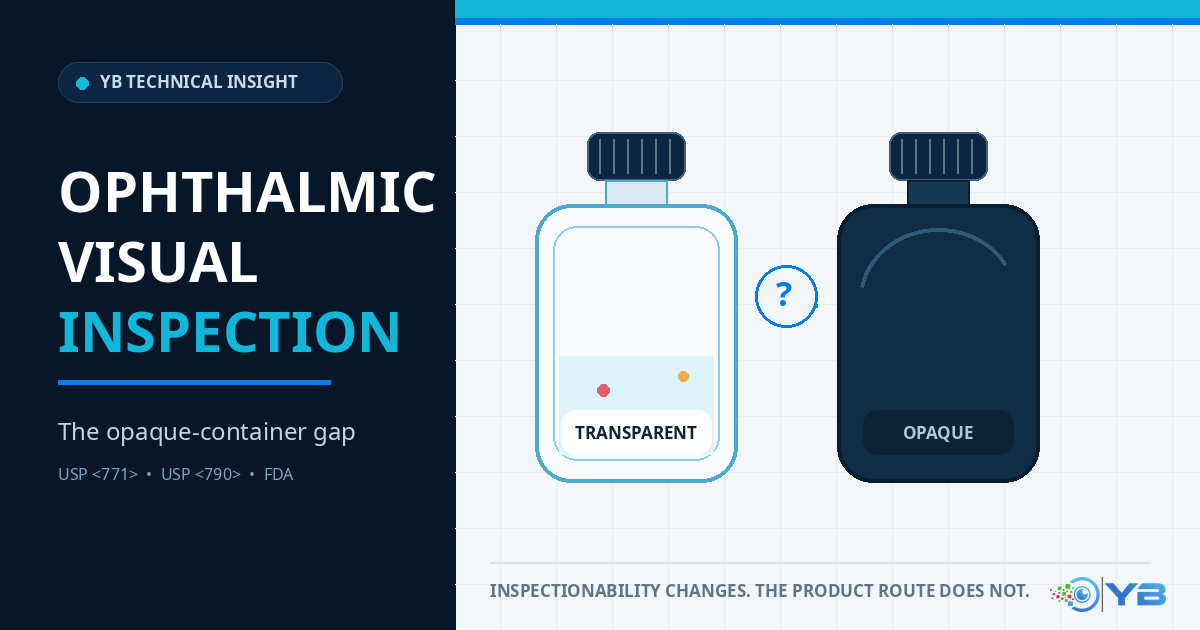
The central problem is not whether ophthalmic products need particle control. They do. The problem is how to demonstrate control when the marketed unit cannot be inspected through the package.
The first distinction: topical ophthalmics are not injectables
USP <771> defines ophthalmic products broadly as sterile products intended for application to an ocular structure or an adjacent space.1 That category includes topical solutions, suspensions, emulsions, gels, ointments, and creams, as well as products administered by intraocular or extraocular injection.1 2
These presentations should not be treated as though they have the same exposure route or risk profile. A topical eye drop placed on the ocular surface is not an intravitreal or intracameral injection. An intraocular injection is still an injectable product and must be assessed under the relevant injection requirements.
The apparent contradiction arises because the current USP framework uses <771> to route ophthalmic products to other particulate chapters. A 2025 peer-reviewed PDA Journal case study reports that <771> instructs topical ophthalmic solutions to undergo visible-particle inspection as described in USP <790>, Visible Particulates in Injections.3 FDA's December 2023 draft guidance, which contains nonbinding recommendations, notes that USP-recognized ophthalmic products are generally required to meet <771> and recommends that noncompendial ophthalmic products also follow that chapter.2
That is more precise than saying, “eye drops are treated as injectables.” The product remains topical; <771> cross-references an established visible-particle inspection procedure.
| Product presentation | Regulatory logic | Practical implication |
|---|---|---|
| Topical clear solution | Ophthalmic product under <771>; the 2025 PDA paper reports that <771> directs topical solutions to <790> for visible-particle inspection.3 | A direct <790>-style examination may be feasible only if the product and marketed package provide adequate visibility. |
| Topical suspension or emulsion | Still a topical ophthalmic product, but intended dispersed material can obscure or mimic foreign matter. FDA recommends particle-size stability evaluation for suspensions and emulsions.2 | A transparent bottle does not by itself make the formulation inspectable. A matrix-specific supplemental method may be required. |
| Gel, cream, or ointment | Covered by FDA's topical ophthalmic guidance; the matrix does not support ordinary swirl-and-view inspection.2 | Dilution, dissolution, filtration, microscopy, or another qualified method may be needed, depending on the formulation. |
| Intravitreal, intracameral, or other intraocular injection | It is an ophthalmic injection, not a topical product. <771> uses route-specific particulate requirements, including the applicable visible and subvisible chapters.1 4 | Do not apply a lower-risk topical rationale to an intraocular injection. |
The opaque-container problem
Topical ophthalmic solutions, suspensions, and emulsions are commonly supplied in opaque or semi-transparent plastic dropper systems. The plastic dropper format provides break resistance and enables controlled drop delivery, but the marketed unit may not allow the analyst or inspection system to see the full contents.3
The 2025 case study makes the physical limitation explicit: direct 100% content inspection is impossible through an opaque container containing pigment such as titanium dioxide and can remain difficult through unpigmented polyethylene because the material is not fully optically clear.3
FDA recognized the same problem in its December 2023 draft guidance, which contains nonbinding recommendations:
“For topical ophthalmic drug products packaged in opaque containers, appropriate technologies (e.g., X-ray spectroscopy) or destructive testing should be used to identify particulates within the accepted visible size range.”2
This statement is important, but its regulatory status must be stated correctly. The document is draft guidance containing nonbinding recommendations. X-ray is provided as an example, not as a universal requirement, and any technology would have to demonstrate adequate performance for the relevant package, formulation, particle materials, and sizes.2
If the bottle were transparent, would the rules change?
The product category and route-based requirements would not change. A topical solution in a transparent bottle remains topical. An intravitreal product in a transparent syringe or vial remains an injection. Transparency changes the feasibility of the inspection method, not the route of administration.
For a clear solution in an optically suitable transparent package, direct examination of the marketed unit becomes possible. That can support inspection of every filled unit rather than relying primarily on destructive sampling. The method would still need to be qualified through the actual package and product. Wall thickness, molding haze, scratches, labels, container geometry, fill volume, solution color, lighting, manipulation, inspection pace, and the selected challenge defects can all affect detection capability.3 5
For a suspension, emulsion, gel, cream, or ointment, a clear package solves only part of the problem. If intended formulation structure blocks or confounds particle detection, the product remains difficult to inspect even when the container wall is transparent.2 3
Japan provides a useful comparison. JP XVIII states that transparent tight containers that do not disturb the Foreign Insoluble Matter Test <6.11> are usually used for ophthalmic liquids and solutions.6 JP <6.11> examines ophthalmic solutions with the unaided eye under a white light source at 3,000–5,000 lx and requires them to be clear and free from readily detectable foreign insoluble matter.6 The wording is not absolute: JP also recognizes that a low-moisture-permeability container or package may be used for products susceptible to water loss.6
The Japanese text shows that transparency can be addressed in a pharmacopeial framework. It also shows why a universal mandate is difficult: even a transparency preference is qualified by product-protection needs.
What can be done when the marketed unit is opaque?
The available evidence supports three broad strategies. They are not interchangeable, and each must be justified for the specific product.
1. Destructive transfer of a clear solution
The PDA Journal case study describes opening a statistically selected sample, transferring the contents into a verified-clean transparent inspection vessel, and applying the normal <790>-style lighting, black-and-white backgrounds, gentle manipulation, and inspection pace.3
The method is straightforward in concept but vulnerable to artifacts. Opening, rinsing, decanting, pooling, and handling can introduce particles, lose particles, or generate particles from the package. A defensible procedure therefore needs controlled handling, verified-clean receiving vessels, background blanks, suitable environmental controls, trained analysts, and evidence that the method recovers representative defects without creating false positives.3
Destructive sampling is not equivalent to 100% inspection. It evaluates a statistically justified subset because the accepted marketed units cannot be examined through the package. The 20-unit example described in the case study is the authors' implementation using special sampling levels from ANSI/ASQ Z1.4; it should not be presented as a universal USP sample-size requirement.3
2. Qualified non-destructive technology
FDA's draft guidance suggests that, for opaque topical ophthalmic containers, appropriate technologies such as X-ray spectroscopy or destructive testing could be considered.2 Separate peer-reviewed research has demonstrated that optimized X-ray imaging can detect seeded steel, glass, stopper, polymer, and organic particles in lyophilized pharmaceutical vials.7
That proof of concept does not establish universal performance for ophthalmic liquids. X-ray response depends on material contrast, thickness, geometry, product background, detector performance, exposure, and image processing. A system must be challenged with the actual product-package combination and representative particles. The correct claim is that X-ray may be a viable non-destructive option, not that it will detect every relevant contaminant.2 7
3. Matrix-specific clarification, separation, or filtration
For suspensions, the case study describes dissolving the intended suspended drug with a suitable filtered solvent before inspection. The solvent must not precipitate excipients, dissolve the foreign particles of interest, or create misleading artifacts. Filter compatibility and recovery must also be established.3
For some emulsions, controlled destabilization or phase separation may produce transparent phases that can be inspected with a qualified method. Suspensions, emulsions, gels, and other viscous matrices may also be processed by membrane filtration, followed by microscopic examination of retained material.3
These approaches are formulation-specific analytical methods—not universal replacements for visual inspection. They require method development, recovery studies, blanks, controls, and scientific justification.
Why does the industry not simply require clear ophthalmic bottles?
The short answer is that pharmaceutical packaging standards are generally performance-based and product-specific, not a mandate to use one material or one optical property.
FDA regulations require the container-closure system to be compatible with the drug, provide protection against foreseeable deterioration or contamination, and be clean and suitable for its intended use.8 ICH Q8(R2) similarly expects the choice of the commercial container-closure system and primary packaging materials to be justified for the product's intended use, storage, transport, integrity, and potential interactions.9
For ophthalmic products, the package is also part of the delivery system. FDA's topical guidance addresses microbial protection, tamper evidence, tip opening, cap torque, drop size, dose delivery, redispersibility, and water loss through semi-permeable packaging.2 10 A material or design selected only for transparency could change mechanical behavior, moisture transmission, compatibility, extractables and leachables, sterilization response, drop formation, or patient usability.2 8 9
This does not mean inspectionability should be ignored. It means that inspectionability must be designed alongside—not in place of—sterility, stability, compatibility, and delivery performance.
The real guidance gap
It would be inaccurate to say that there is no guidance. Several pieces already exist:
| Existing source | What it contributes | What it does not fully provide |
|---|---|---|
| USP <771> and <790> | Ophthalmic quality framework and a visible-particle inspection procedure referenced for topical solutions.1 3 | A complete ophthalmic-specific method for every opaque package and formulation. |
| FDA 2023 draft topical ophthalmic guidance | Explicit recognition of opaque containers and examples of destructive or X-ray-based alternatives.2 | A validated universal method, acceptance plan, or technology performance standard. |
| PDA TR-79 | Lifecycle principles for difficult-to-inspect parenterals.11 | A dedicated, compendial topical-ophthalmic blueprint. |
| 2025 PDA Journal case study | A practical destructive-testing model, historical trending, packaging-component evaluation, and process-capability approach.3 | A binding industry standard or universally transferable acceptance criterion. |
| JP XVIII | A clear preference that transparent tight containers usually be used for ophthalmic liquids and solutions.6 | An absolute transparency mandate applicable to every product and market. |
| Ph. Eur. Eye Preparations (1163) | Eye-preparation quality requirements, including newer subvisible-particle provisions for products used in the injured eye or during surgery.12 | A harmonized global design-for-visible-inspection standard equivalent to the missing blueprint described above. |
The gap is therefore not the absence of particle-control expectations. It is the absence of a single harmonized, ophthalmic-specific framework that connects:
- package optical performance;
- product matrix difficulty;
- representative challenge particles;
- direct-inspection probability of detection;
- destructive-test recovery and contamination controls;
- non-destructive technology capability;
- sampling rationale and acceptance criteria; and
- upstream component, filtration, filling, and stability controls.
ICH Q4B Annex 3 harmonizes recognition of certain subvisible-particle procedures for injections, but it does not provide a harmonized visible-particle or topical-ophthalmic packaging standard.13 WHO's updated sterile-product GMP was developed with the EU and PIC/S, yet it does not supply the missing ophthalmic-specific method.14
A better development model: inspectionability by design
The most defensible path is to treat inspectionability as a formal container-closure and analytical design input during pharmaceutical development.
A practical program should answer the following questions before commercial validation:
- Can the full product volume be examined in the marketed unit under justified conditions?
- If not, is the limiting factor the container, the formulation, or both?
- Which intrinsic, extrinsic, and formulation-related particles are scientifically relevant?
- What detection probability or recovery can the selected method demonstrate for those particles?
- Does aging, storage orientation, transportation, or package variation change optical or analytical performance?
- If destructive testing is used, what is the blank rate, recovery, contamination risk, sample-selection rationale, and acceptance logic?
- Which upstream controls prevent particles rather than merely attempting to find them at release?
This is an expert proposal, not a current compendial mandate. It is, however, consistent with ICH Q8(R2)'s principle that quality should be built into product and process design rather than tested into the finished product.9
Conclusion
The central regulatory point is straightforward once the categories are separated: a topical ophthalmic solution is not an injection, but USP <771> can direct it to the USP <790> visible-particle inspection procedure. When the solution is packaged in an opaque or insufficiently transparent dropper, direct content inspection of every finished unit may be physically impossible. FDA's draft guidance and the 2025 PDA case study support scientifically justified alternatives, including destructive testing and potentially qualified non-destructive technology.2 3
If the same clear solution were packaged in an optically suitable transparent container, the product's route and regulatory identity would not change; direct inspection would simply become more feasible. If the formulation itself is a suspension, emulsion, gel, cream, or ointment, transparency alone would not solve the problem.
The industry does have relevant standards and emerging practice. What it still lacks is a harmonized, ophthalmic-specific design-for-inspectionability framework. Until one exists, manufacturers need a product-specific strategy that integrates package design, method capability, statistical sampling, recovery, lifecycle trending, and upstream particle prevention—and states clearly which elements are requirements, guidance recommendations, or company-defined controls.
References
- USP General Chapter <771>, Ophthalmic Products—Quality Tests, public preview (2022).
- FDA. Quality Considerations for Topical Ophthalmic Drug Products. Draft Guidance for Industry, Revision 1, December 2023.
- Ciolkowski ML, Davis AT, Harding A, Platzer SM. Visual Inspection of Topical Ophthalmic Formulations Packaged in Opaque and Semi-Transparent Containers. PDA J Pharm Sci Technol. 2025;79(1):59–68.
- USP General Chapter <789>, Particulate Matter in Ophthalmic Solutions, public preview (2023).
- FDA. Inspection of Injectable Products for Visible Particulates. Draft Guidance for Industry, December 2021.
- Ministry of Health, Labour and Welfare. Japanese Pharmacopoeia, Eighteenth Edition: General Rules 6-1 and General Test <6.11>.
- Sacher S, et al. X-ray imaging: A potential enabler of automated particulate detection and cake-structure analysis in lyophilized products? Int J Pharm X. 2021;3:100101.
- 21 CFR 211.94, Drug product containers and closures.
- ICH Q8(R2), Pharmaceutical Development, August 2009.
- FDA. Quality Considerations for Topical Ophthalmic Drug Products, Generic Drugs Forum presentation, April 11, 2024.
- PDA Technical Report No. 79, Particulate Matter Control in Difficult to Inspect Parenterals, 2018.
- EDQM. Outcome of the 168th Session of the European Pharmacopoeia Commission, December 2020.
- EMA/ICH. Q4B Annex 3: Test for Particulate Contamination—Sub-visible Particles.
- WHO. TRS 1044 Annex 2: Good Manufacturing Practices for Sterile Pharmaceutical Products, 2022.