SEO title: Compounded Peptide Injectables: What the FDA Vote Means
Meta description: What FDA’s 2026 peptide advisory vote means for 503A pharmacies, 503B facilities, sterile production, and visual inspection of injectables.
Suggested slug: compounded-peptide-injectables-fda-vote-visual-inspection
Category: Regulatory & Compliance
Reading time: 11 minutes
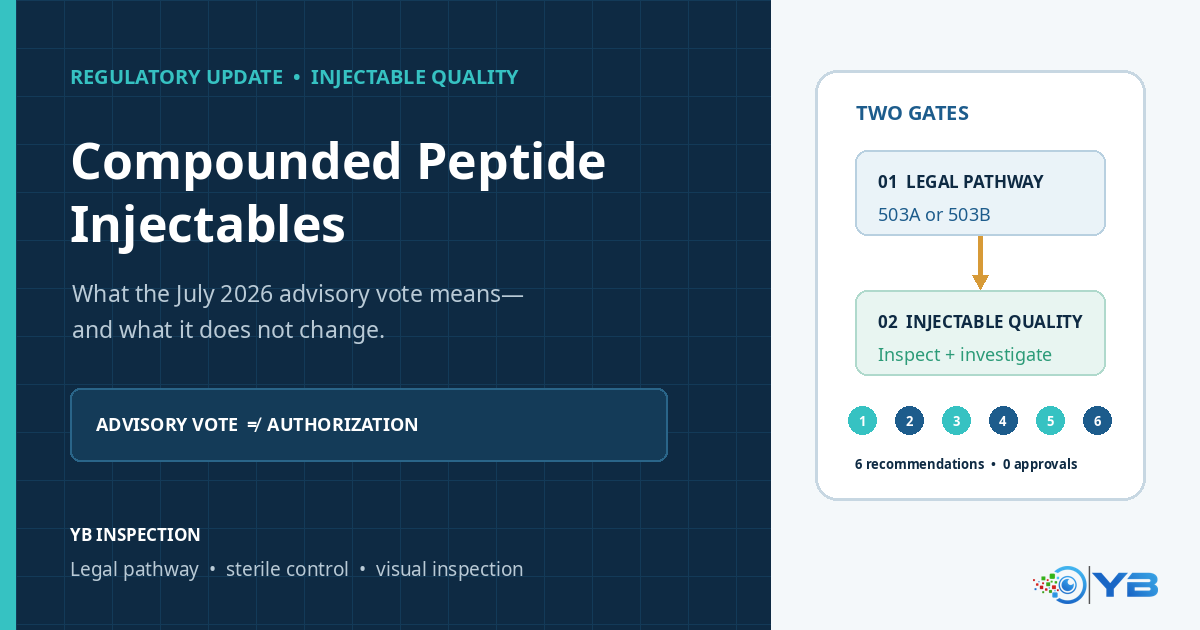
In July 2026, FDA’s Pharmacy Compounding Advisory Committee recommended that six peptide bulk drug substances be added to the Section 503A Bulks List: BPC-157, KPV, TB-500, MOTS-c, Epitalon, and Semax. The committee did not recommend Emideltide.[1] [2]
That was a significant development. It was not FDA approval, it did not immediately authorize pharmacies to compound the six peptides, and it did not create a Section 503B pathway. Advisory committees make recommendations; FDA retains the decision-making authority. As of September 2026, the current text of 21 CFR 216.23 still does not list any of the six peptides.[1] [3] [4]
The most important quality lesson is therefore not that peptide compounding has suddenly become easier. It is this:
A future legal pathway for a bulk substance would not waive the quality system for the finished injection.
If a peptide is ultimately compounded as a sterile injectable under a lawful pathway, it is still a compounded sterile preparation. Its identity, strength, purity, sterility, endotoxin risk, container closure, stability, and finished-unit appearance still require control. Visual inspection remains one important layer—but it cannot carry that entire burden by itself.
What the July 2026 vote actually changed
Section 503A permits eligible state-licensed pharmacies, federal facilities, and licensed physicians to compound under specific statutory conditions. When a compounder uses a bulk drug substance, that substance must follow one of the pathways identified by FDA: comply with an applicable USP or NF monograph; be a component of an FDA-approved drug when no applicable monograph exists; or appear on the 503A Bulks List when neither of those conditions applies. The bulk substance must also be accompanied by a valid certificate of analysis and manufactured by an FDA-registered establishment.[5]
The July PCAC votes addressed the third pathway. They were recommendations about whether FDA should add specific peptide bulk drug substances to the 503A Bulks List. FDA would still need to decide how to respond and complete the applicable rulemaking process before the regulation changes.[1] [2] [3]
| What happened | What did not happen |
|---|---|
| PCAC recommended six peptide substances for possible inclusion on the 503A Bulks List. | FDA did not approve the peptides as drugs. |
| The vote advanced a federal regulatory discussion. | The vote did not amend 21 CFR 216.23. |
| FDA received formal advice from its compounding advisory committee. | Pharmacies did not receive blanket authorization to begin compounding the six substances. |
| The vote concerned Section 503A. | It did not place the substances on the separate 503B clinical-need list. |
This distinction matters in public communications. FDA states that compounded drugs are not FDA-approved and are not reviewed by FDA for safety, effectiveness, or manufacturing quality before marketing.[6] Even a future addition to a bulks list would not establish approval of a peptide for a therapeutic indication. The current regulation expressly warns that representing a compounded drug made with a listed bulk substance as FDA-approved or FDA-endorsed can cause the drug to be misbranded.[4]
503A and 503B are different quality frameworks
The phrase “compounding pharmacy” can obscure two materially different federal pathways.
Section 503A
A qualifying 503A operation compounds for identified individual patients and is primarily overseen by state regulators. Qualifying compounded products are exempt from certain federal requirements, including the approval requirement and federal current good manufacturing practice requirement, when all Section 503A conditions are met.[6] FDA has emphasized, however, that the federal prohibition on preparing, packing, or holding drugs under insanitary conditions still applies.[7]
For sterile compounded preparations, USP General Chapter <797> provides the core compendial framework. USP states that the revised chapter became official on November 1, 2023 and is intended to reduce risks including contamination, infection, and incorrect dosing.[8] Release inspection under the sterile-compounding framework includes evaluating the finished preparation’s expected physical appearance and container-closure integrity before release. Facilities must also evaluate the chapter’s status under the laws, board rules, accreditation standards, and policies that apply in their jurisdiction.
Section 503B
A 503B outsourcing facility registers with FDA and remains subject to federal CGMP requirements. FDA states that a 503B facility may use a bulk drug substance only when the substance appears on the 503B clinical-need list or when the drug product made from that substance appears on FDA’s drug-shortage list at the required times, subject to the other statutory and policy conditions.[9]
The July 2026 PCAC vote concerned the 503A Bulks List. It did not satisfy the separate 503B conditions.
For 503B production, FDA’s January 2025 Compliance Program directs investigators to evaluate 100% post-fill inspection of final filled and sealed product. The program recognizes manual, semi-automated, and automated inspection; it also calls attention to calibrated illumination, specified viewing fields, defect categories, action levels, equipment qualification, challenge tests, and operator training.[10]
| Control question | 503A pharmacy | 503B outsourcing facility |
|---|---|---|
| Is a lawful bulk-substance pathway established? | Evaluate Section 503A conditions and the current 503A pathways. | Evaluate Section 503B conditions, the clinical-need list, and the shortage pathway. |
| What is the sterile-production foundation? | Applicable USP <797>, state requirements, and site procedures. | Statutory CGMP and 21 CFR Parts 210 and 211, with FDA policy and inspection materials. |
| What finished-unit inspection applies? | Visual release inspection of compounded sterile preparations under the applicable sterile-compounding framework. | FDA’s current inspection program assesses 100% post-fill inspection of final filled and sealed product. |
| Does inspection establish clinical effectiveness? | No. | No. |
The injectable presentation changes the quality problem
Whether an active ingredient is approved, investigational, or compounded does not change the route of administration. A preparation intended for injection bypasses several of the body’s natural barriers. That makes control of microbial contamination, endotoxin, visible and subvisible particles, formulation stability, and container-closure integrity especially important.
FDA’s July 2026 PCAC materials also show why peptide products can be more complex than a familiar small-molecule solution. FDA highlighted the importance of identifying the exact bulk substance—free base, salt, or ester—because different forms can have different physicochemical, stability, solubility, pharmacology, and toxicology characteristics.[11] FDA’s peptide evaluations identified concerns that may include incomplete impurity characterization, peptide-related impurities, aggregation, inadequate bioburden or endotoxin information, and potential immunogenicity for injectable use.[11] [12]
Those concerns are not solved by looking at the vial.
What visual inspection can—and cannot—do
Visual inspection is designed to detect observable defects in the finished presentation. Depending on the product and system, that can include visible foreign particles, unexpected precipitation or cloudiness, discoloration, fill anomalies, cracks, leaks, or improper seals.
The process is valuable because it can stop visibly defective units from reaching patients and generate information about process performance. It is also probabilistic: detection depends on particle characteristics, product appearance, container geometry, lighting, presentation technique, inspection time, and the capability of the inspector or automated system.[13]
| Visual inspection can support | Visual inspection cannot establish |
|---|---|
| Rejection of units with visible foreign matter or unacceptable appearance | Correct peptide sequence, salt, ester, or free-base identity |
| Detection of some cracks, leaks, closure defects, fill defects, and cosmetic defects | Potency, purity, or the complete impurity profile |
| Detection of some visible precipitates or aggregates | Sterility of every inspected unit |
| Reject categorization, investigation, and trend monitoring | Bacterial endotoxin control |
| Feedback about filling, components, handling, and stability | Subvisible-particle levels or aggregate characterization |
| Evidence that the finished presentation was inspected under a defined process | Clinical safety or effectiveness |
FDA’s December 2021 guidance on visible particulates describes a holistic, risk-based control strategy involving product development, manufacturing controls, inspection, particulate identification, investigations, and corrective action. That document remains draft guidance, not for implementation, and its defined scope generally addresses approved injectable drugs and licensed biological products.[13] It provides useful technical context, but it should not be presented as a final rule that automatically governs every 503A pharmacy.
For 503B outsourcing facilities, the stronger current connection is FDA’s 2025 inspection program, which directly addresses 100% post-fill inspection in outsourcing-facility operations.[10]
A credible peptide-injectable control strategy starts before the inspection station
The best inspection program cannot rescue a poorly characterized active ingredient, an unstable formulation, an uncontrolled aseptic process, or an unsuitable container. A defensible program connects the following control layers.
1. Confirm the legal pathway before process development
The first decision is not which light source to buy. It is whether the specific substance, form, dosage form, and compounding pathway are legally supportable. The July advisory vote should not be used as a substitute for that determination. State requirements may also be more restrictive than the federal floor.[2] [5]
2. Control the exact bulk-drug-substance identity
The material must be identified precisely. A common peptide name may not adequately distinguish a free base, acetate, other salt, ester, derivative, or different active moiety. FDA’s PCAC presentation specifically warned that inconsistent or commercial naming can make it unclear what was nominated, compounded, or administered.[11]
A certificate of analysis is necessary under the applicable bulk-substance provisions, but the quality system must still determine whether supplier qualification, identity testing, impurity controls, and specifications are scientifically adequate for the intended preparation.[5] [9]
3. Understand formulation and stability risks
The formulation should be evaluated for solubility, pH, concentration, excipient compatibility, adsorption, aggregation, degradation, storage conditions, and interaction with the container-closure system. A visually clear solution at release is not evidence that it will remain stable throughout its assigned beyond-use date or expiry period.
This matters because some peptide-related material may form during storage rather than filling. Stability observations, particulate findings, complaints, and reject trends should therefore connect to the same investigation and lifecycle-management system. YB Inspection's articles on biologics and high-concentration formulations and surfactant-related particles explore adjacent formulation challenges.
4. Build sterility and endotoxin control into the process
Sterility assurance is created by controlled components, facilities, personnel, equipment, procedures, and a suitable aseptic or terminal-sterilization strategy—not by a finished-product sterility test alone. The applicable program should define microbiological controls, sterilization or filtration controls where appropriate, hold times, environmental and personnel monitoring, sterility testing, endotoxin testing, and deviation handling.[8] [10] [14]
5. Design the final presentation to be inspectable
The product, primary container, fill volume, label placement, and inspection method form one system. A clear solution in a transparent vial may permit direct manual or automated inspection. A colored, opalescent, viscous, or otherwise difficult-to-inspect formulation may require additional development work and a justified supplemental method.
The inspection procedure should define the defect categories, inspection conditions, acceptance and segregation rules, inspector qualification, and escalation path. The Visual Inspector Qualification Toolkit provides an editable starting framework for designing the personnel side of that system. For 503B facilities, FDA investigators are directed to examine these elements as part of post-fill visual inspection.[10]
6. Investigate and trend—not just count
A reject is evidence, not waste to be discarded without learning. The quality system should preserve enough information to determine whether defects are inherent, intrinsic, or extrinsic; whether they cluster by component, line, operator, time, or supplier; and whether the event signals a sterility, stability, equipment, container, or material problem.
FDA’s 503B CGMP draft guidance and current inspection program both emphasize investigations, corrective action, product-defect evaluation, and quality trend review.[10] [14]
The better compliance question
The obvious question after the July vote is:
“Can we compound these peptides now?”
The accurate answer is that the advisory vote itself did not create that authorization.
The more useful quality question is:
“If a lawful pathway is eventually established for a specific substance and presentation, can our system consistently produce, inspect, release, investigate, and trend a sterile injectable whose identity and quality are scientifically controlled?”
That question is harder. It is also the question that protects patients.
What quality teams should prepare now
Organizations monitoring the peptide rulemaking process can use the time before any final FDA action to assess readiness without representing the six peptides as currently authorized. A readiness review can examine whether the organization has:
- a process for confirming the current federal and state legal pathway for each substance and presentation;
- unambiguous material nomenclature, supplier qualification, and incoming controls;
- formulation and stability evidence appropriate to the assigned storage period;
- sterile-process, endotoxin, and container-closure controls matched to the product risk;
- a qualified visual inspection method suited to the formulation and container;
- defect standards and training materials that reflect expected product and process defects;
- documented segregation, investigation, CAPA, complaint, and trending procedures; and
- public communications that never equate compounding eligibility with FDA approval.
These are not peptide-specific shortcuts. They are the foundations of a controlled sterile-injectable operation.
Conclusion
The July 2026 vote changed the peptide-compounding conversation, but it did not change the current 503A regulation. The six favorable recommendations may influence future FDA action; they do not make the substances FDA-approved, authorize immediate compounding, or create a 503B pathway.[1] [2] [3] [4]
If a lawful pathway emerges, the finished injectable will still need a quality system appropriate to its compounding framework. For 503A pharmacies, that includes the applicable sterile-compounding and release-inspection controls. For 503B outsourcing facilities, CGMP applies, and FDA’s current inspection program assesses 100% inspection of final filled and sealed product.[8] [10]
The regulatory door and the inspection station are two different gates. A product must pass both—and visual inspection is only one part of the second.
YB Inspection supports organizations developing defensible visual inspection programs for injectable products, including inspection method design, defect categorization and test-kit strategy, inspector qualification, reject investigation, and lifecycle trending. Contact YB Inspection to discuss a product-specific assessment.
References
- FDA — July 23–24, 2026 Pharmacy Compounding Advisory Committee Meeting
- Buchanan Ingersoll & Rooney — FDA Advisory Committee Voted Yes on Six Peptides. Now What?
- McDermott Will & Schulte — PCAC Backs Majority of Peptides
- Electronic Code of Federal Regulations — 21 CFR 216.23
- FDA — Bulk Drug Substances Used in Compounding Under Section 503A
- FDA — Human Drug Compounding Laws and Policies
- FDA — Insanitary Conditions at Compounding Facilities
- USP — General Chapter <797>, Pharmaceutical Compounding—Sterile Preparations
- FDA — Bulk Drug Substances Used in Compounding Under Section 503B
- FDA — Compliance Program 7356.040, Outsourcing Facility Inspections (January 2025)
- FDA — July 24, 2026 PCAC Presentations on Peptide Bulk Drug Substances
- FDA — Certain Bulk Drug Substances That May Present Significant Safety Risks
- FDA — Inspection of Injectable Products for Visible Particulates, Draft Guidance (December 2021)
- FDA — Current Good Manufacturing Practice Guidance for 503B Outsourcing Facilities, Revised Draft Guidance (January 2020)